
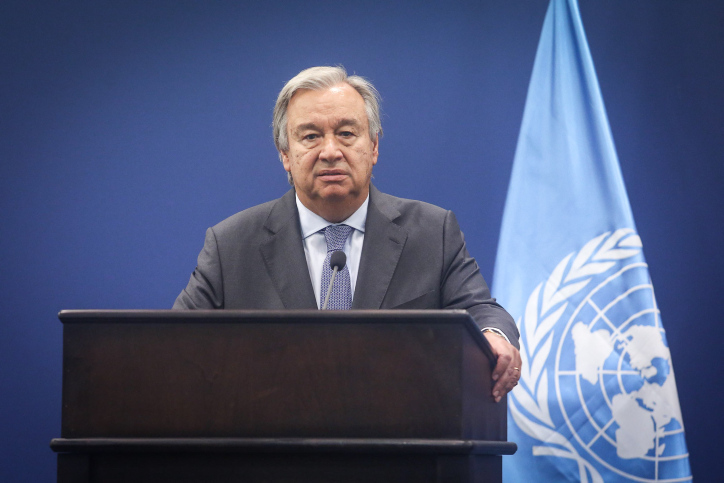
A new study by JPPI - the Jewish People Policy Institute - based on advanced artificial intelligence analysis, indicates a systematic pattern of unusual attitude on the part of UN Secretary-General Antonio Guterres towards the State of Israel, both in the scope and nature of his statements.
This is despite the fact that the nature of his role requires him to demonstrate a fair and neutral attitude towards all countries in the world.
The study, conducted by analysts from JPPI's Glazer Information Center, examined more than 1,100 official statements by Portuguese UN Secretary-General Guterres since he took office in 2017 and until April 2026, as delivered to journalists or published on the UN website, and compared Israel with other selected countries accused of human rights violations - including: Iran, China, Russia, North Korea and Qatar.
The analysis included both a quantitative measurement of the scope of references and a sentiment (tone) analysis of the statements, using advanced tools based on artificial intelligence.
Number of statements: Israel leads, by a significant margin
The data shows that Israel is the country most mentioned in the statements of the UN Secretary-General, by a significant margin from the other countries mentioned.
The volume of references is even higher than in major countries such as Russia, and reaches almost three times that of Iran.
There are also no surprises in examining sentiment: over half of the statements regarding Israel have a negative tone, the highest rate of all the countries mentioned above.
On the other hand, for the sake of comparison: the tone towards a country like Iran is mostly neutral, and there were even more positive than negative statements.
No negative statements were found towards China. Qatar was particularly favorably treated. Even when criticism is leveled at Russia, the scope is less than that directed at Israel.
The study also indicates a clear trend of increasingly harsh tone toward Israel throughout the UN Secretary-General's tenure, especially in recent years.
Guterres has expressed support for Israel's right to exist and security on several occasions, condemned the October 7 attack, and even met with families of hostages and called for their release, but a qualitative analysis of all of his statements reinforces the numerical picture and points to a consistent pattern: Even when the UN Secretary-General condemns terrorism against Israel, the emphasis quickly shifts to criticism of its policies.
Even when there is recognition of Israel's right to security, it is not expressed with a similar intensity to that of the criticism directed at it.
For example, in a statement from October 13, 2023, just days after Hamas's criminal terrorist attack in which hundreds of Israelis were murdered and kidnapped, the UN Secretary-General began by stating: "The situation in Gaza has reached a new dangerous low.".
The Secretary-General did condemn the terrorist attack, but he devoted a relatively brief comment to it, while the bulk of his remarks were directed at harsh criticism of Israel, including regarding the evacuation of the population in Gaza and the claims that the health system in Gaza was damaged:
""Moving more than a million people across a densely populated war zone to a location without food, water or shelter, with the entire territory under siege, is extremely dangerous – and in some cases, simply impossible.""
In a statement from January 2024, he also defined Israel's attacks on Gaza as "the most powerful campaign of destruction" since he was elected Secretary-General: "The relentless Israeli bombing... is the most powerful destructive campaign waged since I became Secretary-General.""
And in another statement from August 2025, he directly accused Israel of harming civilians, medical teams, and journalists, describing its actions as "atrocities," with only minimal mention of the hostages and the terrorism that led to the fighting: "One attack followed another – killing civilians, including medical staff and journalists doing their essential work. All before the eyes of the watching world. I know that many of the reporters here – along with us – have lost dear colleagues. These attacks are part of an endless catalog of atrocities."
As mentioned, the study presents a consistent picture of bias in the pattern of statements by the UN Secretary-General towards Israel, both in quantity and tone. Israel receives an unusual amount of references and an especially high level of criticism, while other countries, including those accused of systematic human rights violations, receive moderate, neutral, and sometimes even sympathetic treatment. The findings raise questions about the objectivity of someone who holds one of the most influential positions in the international arena.
The data was collected and analyzed by Glazer Center researchers at the Jewish People Policy Institute, Shlomi Bareznik, Eli Kanai, and Yaakov Katz.