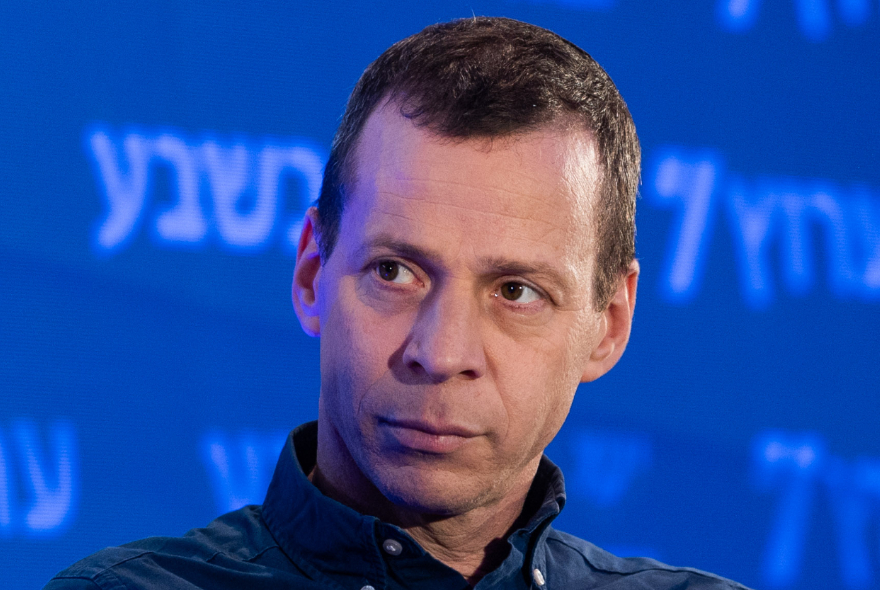
MK Sharan Haskel arrived today (Sunday) at the police's Lahav Unit 433, where she gave testimony in an ongoing investigation surrounding the selection process for the State Comptroller - this against the backdrop of an affidavit she submitted to the High Court of Justice in her request to split from the 'New Tikva' faction.
However, Haskel's testimony failed to connect the claims regarding the requirement to photograph the vote on Attorney Rabilo's election to the Likud. Haskel claimed that MK Michel Buskila of Tikva Hadasha was the one who ordered the vote to be photographed.
According to police sources, Haskel's testimony was not strong enough, as it was brief and lacking in details. According to the same sources, these are general statements that are not supported by evidence.
Legal commentator Avishai Greenzig revealed on i24 that Minister Gideon Sa'ar submitted a scathing affidavit to the High Court of Justice, in which he attacked her claims.
In an affidavit, Saar claimed that Haskel's claims "are incorrect and baseless, no demand was made from the Likud to record the vote. I myself made it clear to the members of 'New Hope' that they were not supposed to record themselves, when rumors broke that Knesset members intended to record themselves. To the best of my knowledge, no 'New Hope' MK has sent in his documentation.".
Later in the affidavit, Sa'ar further sharply criticized Haskel, writing that the affidavit she attached regarding the State Comptroller "includes misleading and incorrect details, to say the least," and that "above all, there is a feeling that these affidavits were included to try to create a kind of media provocation, when it is clear that their connection to the subject of the petition is extremely loose.".
According to him, the affidavit on the State Comptroller's affair was not intended to help decide the petition filed by Haskel about merging the parties, but rather to create public and media resonance.
Haskel's affidavit stands in complete contradiction to the denial affidavits submitted to the High Court on behalf of Likud Director General David Sharan and other MKs from the party, who categorically denied that there was a demand to record the votes.
Due to this contradiction in the affidavits, Attorney Gali Baharav-Miara ordered an investigation to be opened.
Legal commentator Avishai Greenzig wrote: "Haschel's investigation was careless and amateurish, and she did not confront the multitude of evidence and materials. The investigators acted according to the Attorney General's instructions - to check whether she had proof for her claims, and not to interrogate her with a warning. And if I may - this is scandalous conduct by the Attorney General.".
Greenzig claimed that there was justification for opening a criminal investigation into the affair, but according to him, Rabbi Meara only ordered an investigation into whether Likud MKs submitted false affidavits. He claims that the possibility that Haskel herself submitted a false affidavit, given the contradictions in the versions and affidavits submitted, is not being examined at this stage.
According to him, this means that if no suspicion is found against Likud members, the case will lose interest from the investigators' perspective.
Political commentator Amit Segal reacted sharply to the development: "Saar submitted an affidavit to the High Court of Justice in which he wrote that not only was no instruction given to take pictures, but that he reminded the Knesset members not to record themselves.
""The attorney general, who rushed to open an investigation when it seemed she could catch the coalition in a false affidavit - is silent. She did not order an investigation with a warning to the mind.".
""If it were the chairman of the Democratic faction, this would be logical behavior. The opposition is supposed to find every reason to criticize the government, and ignore what is inconvenient. And this is exactly how the ombudswoman perceives her role: the chairman of the opposition - to oppose every appointment, to filibuster every process, to oppose every law, to only address what is convenient.".