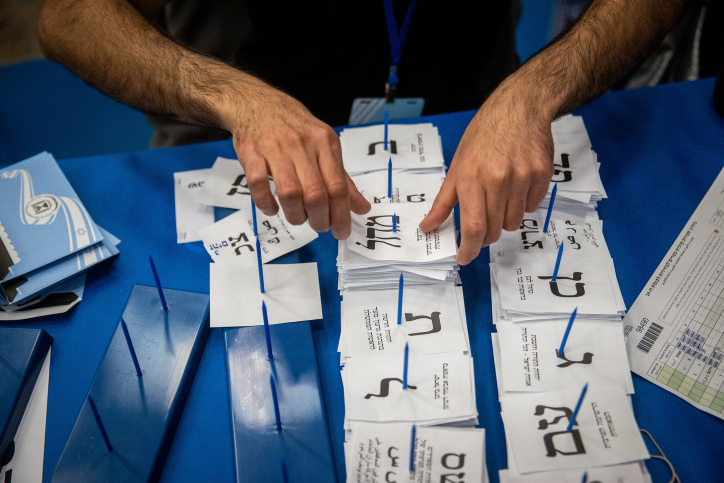
The Knesset committee headed by MK Ofir Katz approved the party financing bill for the 26th Knesset for second and third readings this evening (Sunday).
The committee members approved the recommendations of the public committee on party financing in the elections to the 26th Knesset, which require an amendment to the Party Financing Law.
Within this framework, a 'moderate' arrangement is proposed that will include, among other things, the distribution and offset of loans received by the factions from the Knesset. In addition, the rate of the election financing advance will be 80% from a financing unit per Knesset member instead of 70% as is currently customary.
Another approved recommendation relates to amending Section 3 of the law so that in the upcoming Knesset elections, the additional funding for the election for the faction will be 1.4 funding units instead of one unit currently.
In addition, the public committee recommended establishing two unique provisions for new parties and candidate lists that are not represented in the Knesset. These parties that have notified the Knesset Accountant of their intention to run in the elections will be able to receive an advance payment of 2 funding units starting from the determining date - subject to depositing a guarantee.
After the stage of submitting candidate lists, these parties will be entitled to an increased advance payment of 10 funding units against a guarantee, with the advance payment, if received previously, being offset from this advance payment.
The public committee's reasoning states: "The Party Financing Law gives significant priority to parties represented in the Knesset over 'new' parties, and in order to open the doors of the legislature to new parties to a certain extent, these laws included provisions that were intended to benefit new parties to a certain extent.".
The total cost of the aforementioned changes is estimated by the Knesset Accountant at approximately 33 million NIS, in addition to benefits, which mainly include debt distribution and a change in financing payment dates.
""The public committee sees the issues detailed in this document as interrelated, balancing large and small parties and old and new parties, and minimizing inequality and the fear of sunk debts. The recommendation is that the legislative amendments be adopted as a single package," the public committee's appeal to the Knesset committee reads.
An additional clause was added to the text of the law stating that the Knesset will go into an election recess on July 17.
The Knesset's legal advisor, Attorney Sagit Afik, clarified that because the current Knesset is expected to complete its term and because the election date set by law is October 27 and there is no intention to shorten the Knesset's term, the "Knesset Dissolution Law" in its usual sense is not required.
Despite this, Adv. Afik recommends officially setting the date for the election recess as July 17, and introducing this as an amendment to the party financing bill, as was done in the past when the financing issues and the dispersal law were passed together.
The Knesset Legal Advisor added that during the recess period, a Consent Committee will operate, consisting of the coalition chairman and the opposition coordinator, and that debates and bills during this period will only be conducted with the consent of this committee.
The committee's legal advisor, Attorney Arbel Astrakhan, added that alongside the committee's recommendations, the public committee decided that "the law entrusts it with the authority to determine the amount of the funding unit, which will be 1,835,000 shekels per Knesset member, reflecting an increase of 12%.".