
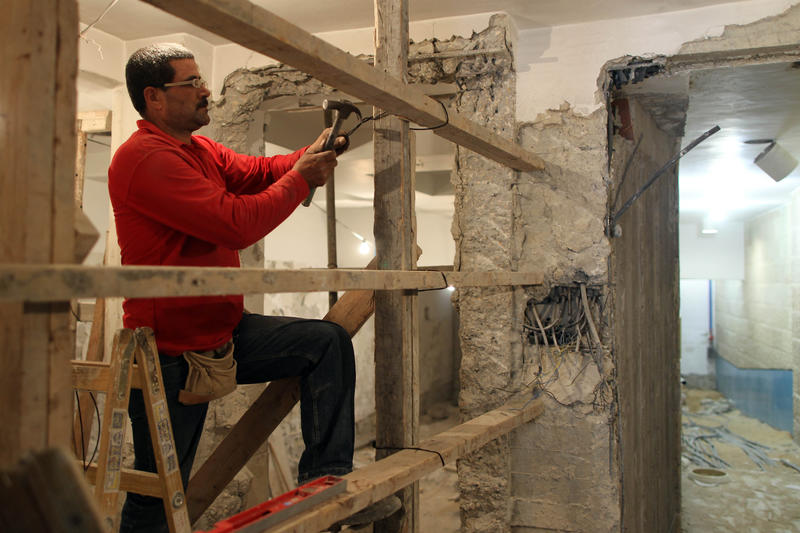
About three and a half years ago, A., a freelancer in the field of renovations, went out for a routine work day at a construction site.
While working, a nail gun exploded in his hands, causing a blast and an unusually loud noise. He said that immediately after the explosion, he heard a loud ringing in both ears, and in the days that followed, he suffered from significant hearing loss and persistent tinnitus.
Later, he also began to suffer from severe headaches that he had never experienced before.
According to him, the disturbing tinnitus and the annoying headaches have not gone away, while they affect his quality of life on a daily basis.
In his distress, A. turned to attorney Sivan Sofer, who specializes in obtaining medical rights from work accidents. She filed a lawsuit on his behalf with the National Insurance Institute to recognize the incident as a work injury, and to recognize the hearing loss, tinnitus, and headaches as disabilities caused by the accident.
Her request was accepted, the incident was recognized as a work accident, and A. was awarded injury benefits for three months.
Later, the National Insurance Institute recognized hearing loss, tinnitus, and headaches as injuries caused by the incident.
The medical committee appointed to him determined that the tinnitus he began to suffer from constituted a ten percent disability, and for this reason he was paid a one-time grant of approximately 154,000 shekels.
However, the committee determined that A. does not suffer from hearing loss that qualifies for disability, and that although the headaches were recognized as a work injury, he did not have any remaining disability percentages for them, and therefore did not grant him additional disability due to this component.
Attorney Sivan Sofer filed an appeal against this decision, to which was attached a neurological opinion, in which it was determined that the severe headaches from which A. suffers stem from the accident and that this is a chronic syndrome. The expert noted that this is a recurring pain of varying intensity, which has continued since the accident and is affecting his functioning.
However, the appeals committee decided not to conduct an additional physical examination on A. In its decision, it determined that there was no causal connection between the headaches he was suffering from and the work accident, and rejected the demand to determine additional disability percentages for them.
Following the decision, Attorney Sofer filed an appeal with the Regional Labor Court, which can only be appealed on a legal question. In the hearing before the court, it was argued that the appeals committee exceeded its duty when it denied a connection that had already been recognized due to the recognition of the accident and the injuries that were caused by it, and that it should have ruled only on the question of the degree of disability.
It was further claimed that the decision was not sufficiently reasoned and that sufficient weight was not given to the neurological opinion and the medical documents.
The court heard the parties' arguments. During the hearing, it proposed returning A's case to the appeals committee for a reexamination of the headache issue, with detailed reference to the medical material presented.
The parties agreed to the proposal, and the court gave it the force of a judgment.
After the file was returned, the medical committee reconvened and decided to change its previous decision and accept the insured's claims, while determining that, although this was an event of sudden exposure to noise without direct head injury, there is room to recognize the headaches as a disability related to the event.
Thus, following the recognition of the claim and the determination of disability for tinnitus and headaches, A. received compensation of over 270,000 shekels.
According to Attorney Sofer, beyond the significant amount awarded, the recognition of the disabilities from which A. suffers has broad future significance. According to her, if in the future there is a deterioration in his medical condition in the same impairments that were recognized as a result of the work accident, he will have the option of submitting a request to increase the disability rate due to the worsening of his condition, and if this request is accepted, he will be entitled to additional benefits.
Attorney Sofer adds and notes that if in the future the disabilities affect his performance at work, it will be possible to request the activation of Regulation 15 of the National Insurance, which allows, in cases of impaired performance, to increase the degree of medical disability by up to an additional 50 percent.
Attorney Sivan Sofer, who has represented insurance companies in personal injury claims for years, now specializes in battles against insurance companies to restore medical rights for nursing home patients, loss of work capacity, personal injuries, and more.