
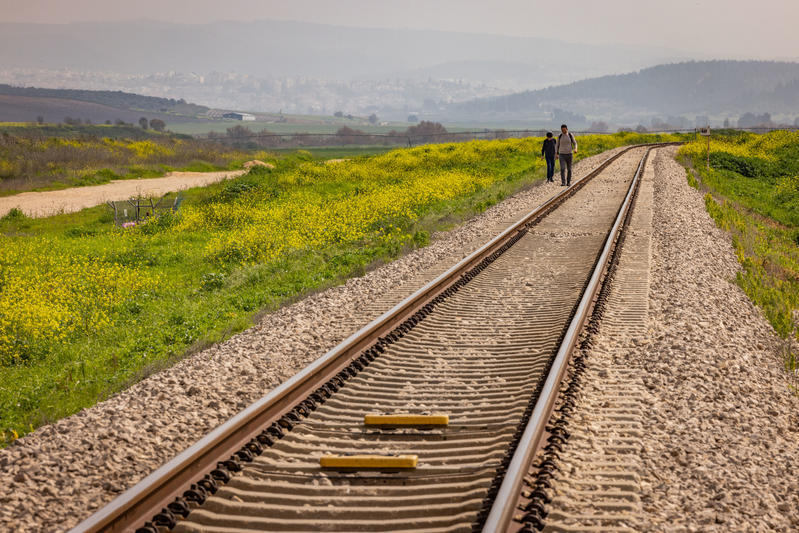
The Ministry of Transportation and Road Safety continues to promote the high-speed rail project between Tel Aviv and Haifa, which will shorten the travel time between the two cities to approximately 30 minutes.
The project is a central pillar of the 'Connecting Israel' vision and the establishment of a high-speed intercity rail network that will connect the largest metropolitan areas in Israel in the future.
The National Infrastructure Committee (NIC) today (Monday) approved the Ministry of Transportation to begin work to upgrade and expand the coastal railway between the Carmel Beach station and Shafayim.
This is the central and longest section of the high-speed rail route between Haifa and Tel Aviv, which will significantly increase travel speed, train frequency, and passenger capacity on the country's busiest central route.
The plan, which extends over a route of 68 kilometers, includes the expansion of the coastal railway to four tracks: two tracks for high-speed intercity trains up to 250 km/h, and two tracks for suburban and regional trains. On the route between Netanya and Shafiyim, four tracks for suburban trains are planned in order to meet demand.
The separation between the types of service will allow high-speed trains to operate without the delays currently caused by the shared use of high-speed trains, suburban trains, and freight trains on the same tracks.
According to the plan, the high-speed trains will complete the journey between Haifa and Tel Aviv in about 30 minutes, with a limited number of stops. At the same time, the suburban service will operate with high frequency and stop at stations along the route, improving travel times, service reliability and accessibility to localities in the area.
The high-speed rail between Tel Aviv and Haifa will in the future be integrated into the national high-speed rail network and connect to the high-speed line to Ben-Gurion Airport and Jerusalem and the planned high-speed rail lines to Beer Sheva. This will create a fast and continuous rail route between the north of the country, the Dan Bloc, Jerusalem and the Negev, which will allow for fast and convenient transit between Israel's four main metropolitan areas.
Increasing the track capacity is expected to allow the operation of more trains and transport up to 30,000 passengers at peak times in each direction. The move is part of the railway's development plan and is intended to provide a response to the expected increase in the number of passengers, which is expected to reach approximately 300 million trips per year by 2040, and to strengthen the railway as the backbone of national public transportation.
The plan includes upgrading and expanding existing passenger stations and establishing new stations in accordance with demand forecasts and the development of the communities along the route.
Among other things, a new passenger station is proposed in the area of the Highway 4 intersection and the access to Binyamina and Or Akiva, which will replace the existing station in Binyamina and improve service to the demand area.
The plan is intended to enable fast and continuous travel, improve accessibility and safety conditions in the area, and reduce the impact of train traffic on the center of the town. In addition, an additional new station will be built in Zichron Yaakov, with the aim of improving service and providing a spatial response to the growing demands in the area.
In addition to adding the tracks, the plan includes arranging grade separations between roads and tracks, upgrading railway infrastructure, constructing engineering facilities, and landscape and environmental treatment along the route. Solutions will be provided for reducing noise and hazards, drainage, ecological transitions, and the restoration of areas that will be affected during the work.