
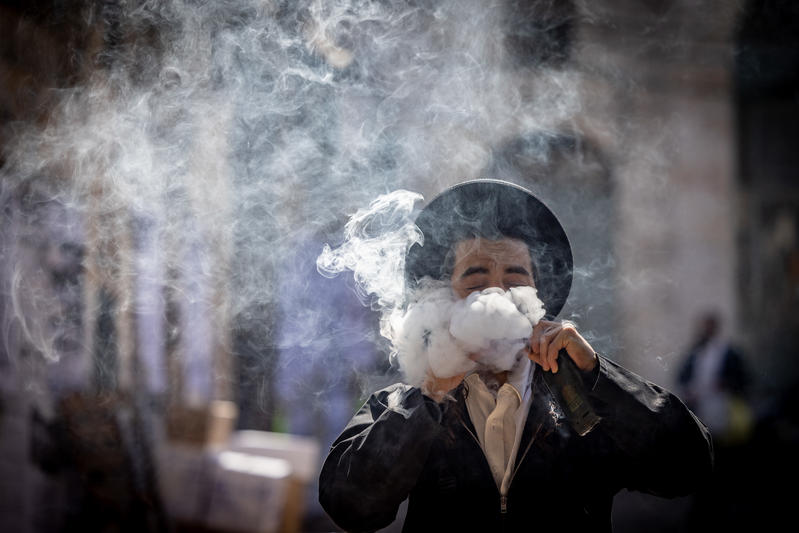
A legislative journey of over 20 years has been completed: The law requiring graphic warnings in deterrent images has undergone a tortuous, lengthy journey, filled with pressure and opposition that lasted for over two decades - in the corridors of the legislature, from an initial bill to final approval in the plenum and later in regulations in the Knesset's Economics Committee.
On Sunday, August 2, the State of Israel will join approximately 140 countries around the world that implement a requirement to print graphic warnings in pictures depicting the harms of smoking.
The picture policy currently covers approximately 661% of the world's population, and is considered one of the most effective tools for deterring smoking and raising awareness of its harms.
The Israel Cancer Association emphasizes that although this is a milestone in the fight against smoking, the images are part of a broad approach and constitute one tool within a complete strategy to reduce smoking and its harms in Israel.
The warnings, which include images and scientific content, are 75% in size from the packaging surface of all tobacco products, including electronic cigarettes, hookahs, rolling tobacco, and nicotine pouches.
Additionally, as part of the area next to the warning, a reference to the National Rehab Center and health funds also appears.
It should be noted that for the purpose of implementing the new legislation, the Health Promotion Department at the Ministry of Health formulated the warnings while taking into account cultural characteristics and religious sensitivities, in order to contribute to the effectiveness of the move among all sectors with the assistance of the coalition of organizations fighting smoking, including the Israel Cancer Association.
Moshe Bar-Haim, CEO of the Israel Cancer Association: "We have been accompanying the struggle to promote warnings throughout the years. This is a very significant and dramatic milestone, as the image creates an immediate connection between the health damage and the product that claims over 1,000 lives in Israel every month from a variety of diseases caused by smoking. A picture is worth a thousand words, and from now on it may also save lives, authentically convey the destructive effects of tobacco, and deter non-smokers as well.".
""At the same time, we are very concerned about the increase in the smoking phenomenon among children and teenagers who use electronic cigarettes and nicotine pouches far from their parents' eyes without understanding the health significance. The fight against smoking is a national goal and must be expressed in a comprehensive approach that also includes vigorous and effective enforcement measures of the law prohibiting smoking in public places, which is not enforced at all and creates a situation that normalizes and perpetuates the smoking phenomenon in Israel.".
""At the same time, we must also work to increase taxation, carry out information campaigns, continue to restrict advertising, and completely ban the sale of smoking products with sweet flavors and scents, which are designed to entice youth to join the circle of addicts through manipulation. We must protect the younger generation from the crushing claws of the tobacco industry. All smoking products, including hookahs, electronic cigarettes, and nicotine pouches, must be left in Israel, only in the original tobacco flavor.""
The implementation in Israel is part of the World Health Organization's Framework Convention on Tobacco Control (FCTC), which the State of Israel signed in June 2003, and ratified two years later in August 2005. The convention is intended to protect the public from the devastating health, social, environmental, and economic impacts of tobacco consumption and exposure to smoke.
Canada was the pioneer country in the world to implement warnings with pictures as early as 2001. In 2018, 117 countries joined, the number of which grew to 138 in 2023 and later, as mentioned, to 140 countries. Starting on August 2, the State of Israel will likely be the 141st country, 25 years after the move in Canada. Further countries are expected to join the implementation of the pictures, such as Iceland and Syria in 2027.
There are countries in the world where 100% of the packaging surface is covered with a daunting image, such as New Zealand, Mauritius, Nepal and Turkey. On the other hand, 47 countries around the world have not yet met the basic minimum requirement of 30% coverage under the Convention.
These days, Australia and Canada are becoming the first countries in the world to become even stricter and require warnings to be printed directly on each individual cigarette.
In Israel, the rest of the packaging area - except for the warning and the 75%-sized image - is a dark brown shade tending towards olive green, which was chosen as the ugliest color in the world (Pantone 448C) and has been implemented in Israel since 2020, without brand colors, logos or design elements.
According to data from the Israel Cancer Association, in 2026 the rate of regular cigarette smokers in Israel will be 241%, with smoking being more common among men (341%). E-cigarette smoking will be about 151% of the population, and much more among young people aged 16-24 (241%).
Hookah smoking increased this year from 11% last year to 15% this year, and there was also an increase in cigar smokers from 2% last year to 5%. According to the data, about 5% of teenagers and young adults experimented with nicotine pouches.
About 76% of smokers want to quit, and even more so among the Arab sector (86%). 72% regret ever starting. About half of the public (46%) know smokers who want to quit smoking but are unable to, and those who smoke themselves know even more (53%). There is a clear divide in the public between those who believe that cigarette prices should be raised through taxes (55%) and those who do not. Among those who do not smoke, 63% believe that cigarette prices should be raised through taxes.
In Israel, every year, approximately 12,386 women and men die from diseases caused by smoking - which is over 1,000 Israelis per month.
The World Health Organization has declared that smoking is the number one preventable cause of premature death in the world and has emphasized that there is no safe level of smoking, and any exposure is harmful to health.