
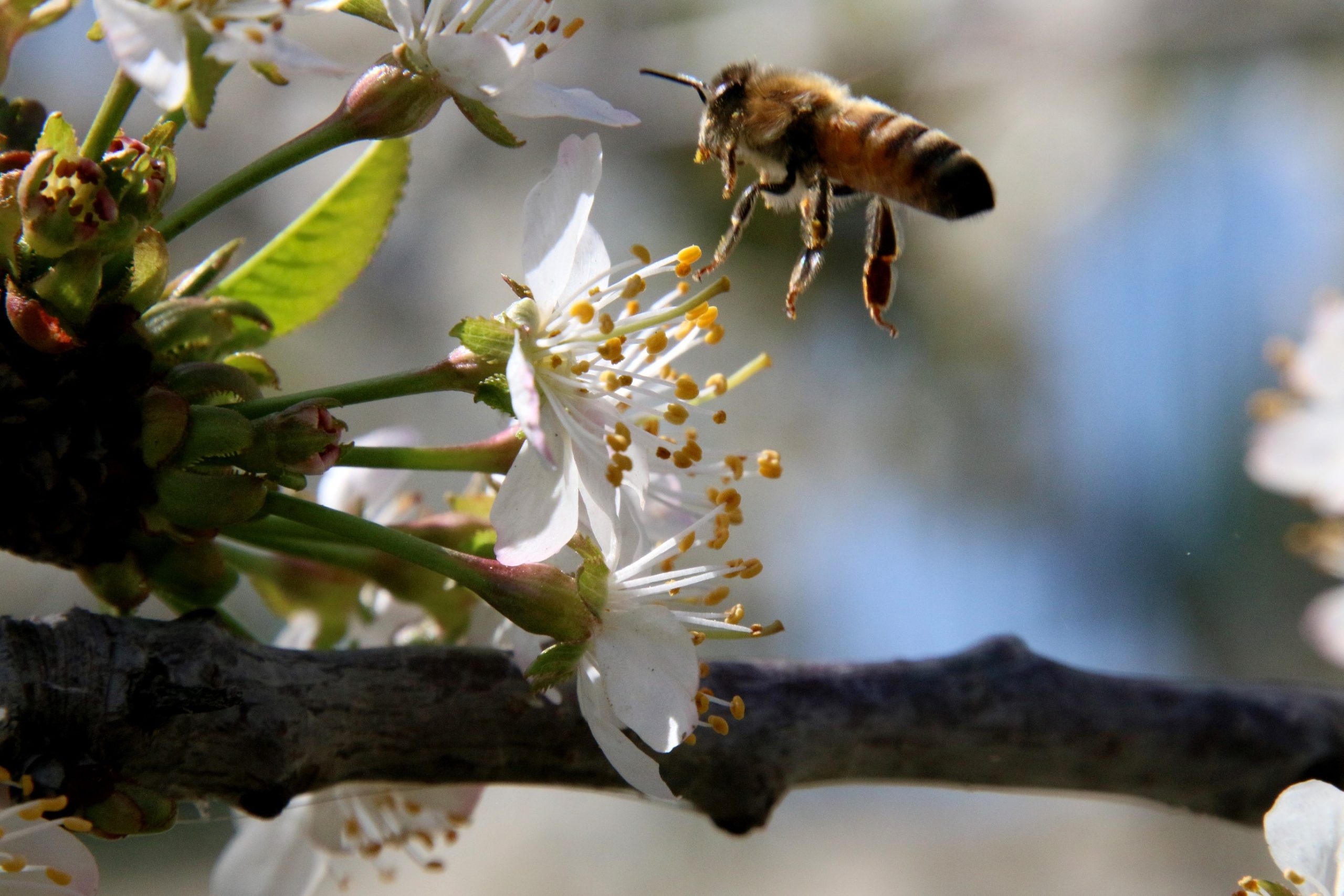
The miraculous abilities of honeybees are well-known and continue to intrigue researchers around the world.
In recent years, scientific interest in the cognitive abilities of honeybees has increased, with researchers divided over whether honeybees really know how to 'count' or whether they merely respond to visual patterns thanks to their highly developed ability to recognize shapes, colors, and smells.
New research conducted at Monash University in Australia, and recently published in the scientific journal Royal Society, indicates that honeybees do indeed respond to the number of shapes and do not just rely on visual cues.
The study suggests a rethinking of the way scientists study bees' worldviews. Unlike past studies that have relied primarily on the human perspective, the researchers in this study considered how bees actually see their environment.
According to them, bees are able to distinguish mainly general patterns and less small and subtle details, so it is possible that some of the previous experiments relied on other visual cues and not truly on "counting.".
For the study, the researchers used a mathematical model that simulates the visual acuity of honeybees, and re-examined visual stimuli from previous studies. They found that images that appeared more 'cluttered' to humans due to a large number of objects did not necessarily appear that way to bees. That is, the fact that an image has more objects does not necessarily indicate that the bees perceive it as more complex.
Dr. Mirko Zenon, a research partner and neuroscientist from the University of Trento in Italy, said in an interview with the Australian website ScienceAlert that the results of the study strengthen the claim that bees have a real sensitivity to numbers.
""When we analyze the stimuli in a way that reflects how bees see the world, what remains is actual sensitivity to numbers," says Dr. Zenon.
""We as humans experience the world very differently from animals, so we need to keep the bee's perspective in mind, not our own, when examining its cognition, otherwise we may underestimate or overestimate its capabilities," says zoologist Dr. Scarlett Howard of Monash University, who co-authored the study. "It can be challenging to put ourselves inside the bee's brain to imagine how it sees the world, but trying to see the world through its eyes is a vital part of our work.".
CEO of the Pollination and Honey Council, Gil Shatzberg: "This important article once again proves the honeybee's miraculous abilities and senses, which give it the ability to act with precision and sophistication in nature. The bee has always amazed researchers around the world, and in recent years, research has been expanded at universities and professional institutes in Israel and around the world in the field of beekeeping, with the aim of discovering how to preserve and protect the most important pollinator in the world, among other things by recognizing and learning its characteristics and abilities, continuing to carry out its work in pollinating agricultural plants that produce food for humanity and animals, and saving it from extinction, due to the disappearance of about a third of the world's bee population.""
Advanced research is currently underway in Israel in the field of honeybees, dealing with, among other things, cognition, nutrition, health, communication, and more. Researchers at research institutions and universities in Israel are examining how environmental conditions, food availability, and climate change affect the functioning of bees and the resilience of colonies, with the aim of developing ways to help preserve the pollinators that are most important to agriculture and the ecosystem.
On May 20, the world will mark International Bee Day, which was decided in 2018 by the UN General Assembly, due to the world's struggle with the disappearance of a third of the bee population, with the first investigated cause leading to this phenomenon being the decrease in food (nectar) for bees, as a result of the urbanization trend.