
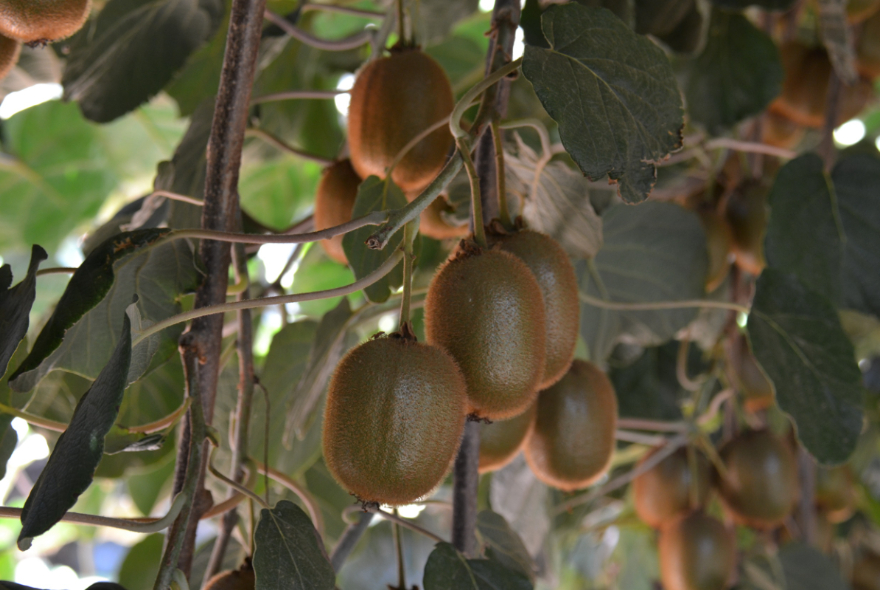
Local 'Hayward' kiwifruit is currently hitting store shelves - but the Plant Council is warning consumers against purchasing it at this stage.
According to the council, kiwi is marketed before it reaches the appropriate ripeness, so it is recommended to wait until it reaches the markets when it is ripe and suitable for eating.
Shai Golani, Chairman of the Kiwi Table at the Plant Council, explains: "The Israeli kiwi is only picked and marketed starting in October, after passing all the mandatory tests that found it suitable for picking and eating.
""Unfortunately, there are currently several local growers who have rushed to market early (unripe) Hayward fruit to consumers. Therefore, we recommend not buying Israeli kiwi now until early October, and at the same time - we have contacted those farmers and asked them to stop the practice immediately. This harms consumers first and foremost, and in addition - it also causes damage to honest kiwi growers, who are of course the vast majority of growers.".
Arna Sandel, Manager of Quality and Standards in the Fruit Industry at the Plant Council: "Israeli kiwi is on the shelves for about 10 months a year, with August and September being a transition period between the end of a season and the beginning of a new season. The two most popular kiwi varieties grown in the country are the 'Hayward' (the variety common in Israel; its shape is round) and the 'Bruno' (an elongated kiwi that tastes relatively sweet).
""We recommend that consumers wait for the ripe Israeli kiwi to be marketed from the beginning of October, when the Israeli kiwi will be at its peak, and its taste will be sweet and wonderful.".
The kiwifruit industry in Israel is an important component of the northern economy, and is grown mainly in the Galilee and the Golan Heights. The annual kiwifruit harvest in Israel is approximately 10,000 tons, all of which are marketed to the local market, with a planted area of approximately 3,200 dunams of yield.
The Israeli kiwi is almost completely free of pests and diseases, and growing it in Israel does not require the use of pesticides. It is best to buy the kiwi when it is relatively hard, and allow it to soften at room temperature. When it is soft, it is ready to eat.
Kiwi is considered a low-calorie and very healthy fruit; it is rich in vitamins, effective in preventing diseases, contributes to bone health, contains anti-cancer effects, and even helps the digestive system function properly.
The Plant Council operates in the public and professional spheres of the agricultural sector as a central factor alongside the Ministry of Agriculture and growers' organizations.
It was established in 2004, and currently consists of 4 different branches: fruits, vegetables, citrus fruits, and the olive branch.
This is a council that operates according to a law that stipulates that growers will have a majority in the institutions that manage it, and alongside them, government representatives, marketers, exporters, and consumers serve in the council's institutions.