
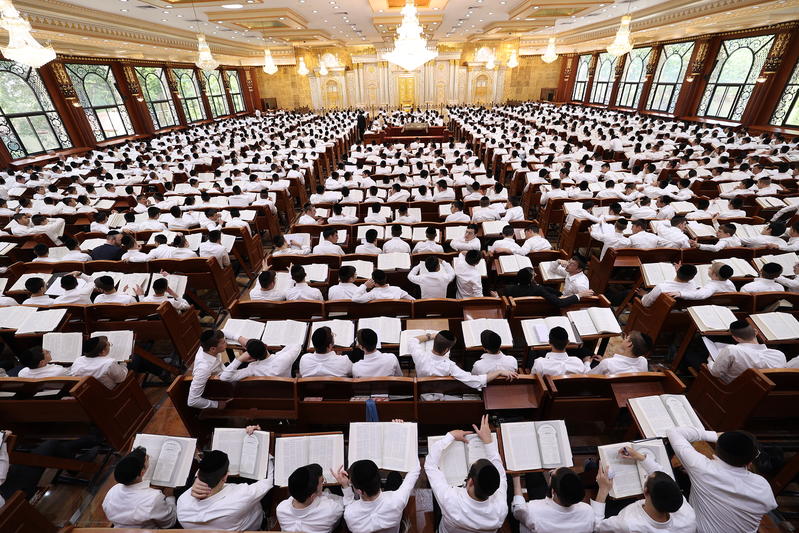
A document from the 'World Torah Foundation', published this morning (Monday) by Mordechai Halperin on the Galei Tzahal radio station, reveals the amount of money raised by the great men of Israel since the foundation's establishment in July 2024 - and how the money was distributed.
The document includes 60 pages and lists more than 1,400 institutions that have received budget since the foundation's establishment until the beginning of 2026, and details the distribution of funds among the various institutions.
According to the data, within about a year and a half, more than half a billion shekels were transferred to about 1,450 institutions, with the aim of providing an alternative to the state budgets that were cut off following the sanctions led by Attorney Gali Baharav Miyara against those liable for conscription.
According to the report, donors are expected to gather soon at the Stay Hotel in Tiberias, where the data and the continued activities of the fund will be presented.
Who received the most?
At the top of the list of recipients of funds is Yeshiva Mir, which received nearly 19 million shekels. It is followed by Yeshiva Ponivez and Aterat Shlomo, with more than 13 million shekels each.
Among the institutions that received additional significant amounts are Yeshivas Siach Yitzhak, Hebron, and Netivot Hochma, which received between 6 and 9 million shekels.
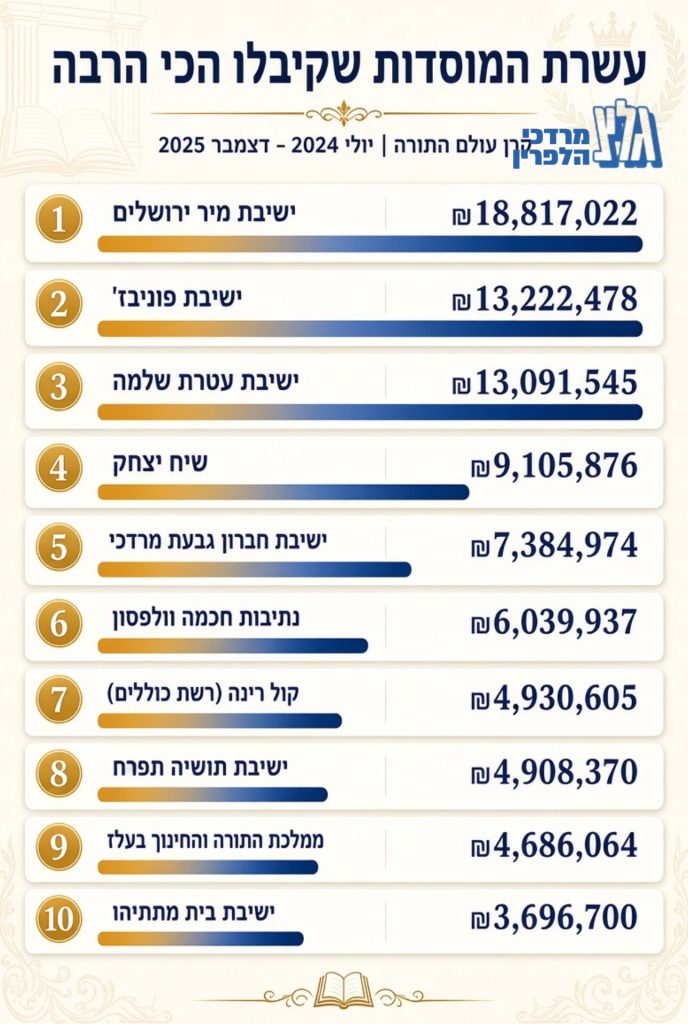
Sha'arei Torah, Tipharech, Beit Matityahu and Beit Hillel are also in the top ten of institutions that received the highest amounts.
The amounts in the document are updated for the beginning of 2026. According to estimates, since this distribution, an additional 200 million shekels have been transferred to all yeshivot.
The fund's activities are intended to enable the yeshiva world to cope with the cessation of government funding and maintain the institutions' activities through private donations. However, according to the report, even among the donors themselves there is uncertainty about the ability to continue raising such large sums over time.
Some admit that the key question is how long this system can be sustained through donations alone.