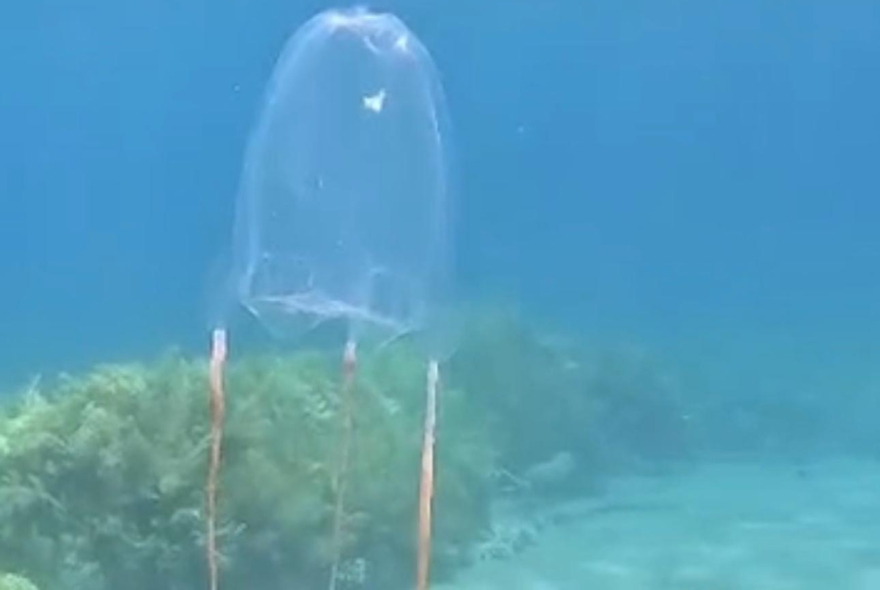
Special documentation in the Gulf of Eilat: A few individuals of the rare cube jellyfish Alatina grandis were recently recorded in the waters of the Gulf of Eilat.
This is a rare species in the area, appearing only rarely, usually following changes in the current and wind regime.
The jellyfish was identified by Dr. Tzafrir Koplik and Prof. Tamar Gia-Haim, based on DNA tests and its unique morphological characteristics, including the square structure of the jellyfish's bell and its arms.
“It is important to clarify – this is not a swarm of jellyfish, but only a few individuals,” says Dr. Assaf Zevuluni, Eilat Bay ecologist at the Nature and Parks Authority. ”The chance of encountering such a jellyfish in the sea is very low, and there is no reason to panic or avoid swimming. Along with enjoying the sea, it is simply important to be aware and familiar with the natural environment.“
The Cuban jellyfish are known worldwide for certain species that are considered particularly dangerous, including the Australian “sea leprosy” (Chironex fleckeri). However, the species documented in Eilat is different. Its sting can be painful and even dangerous, but it does not compare to the strength of the venom of the deadly species from Australia.
The Nature and Parks Authority explains that marine animals may change their distribution area for various reasons, including climatic changes and changes in the current and wind regime. The appearance of the jellyfish in the Gulf of Eilat is part of this phenomenon, but at this stage it is only a one-off event.
The Gulf of Eilat is one of the richest and most ecologically diverse areas in Israel, and therefore an encounter with marine animals is an integral part of a visit to nature.
The Nature and Parks Authority reminds that in any encounter with a jellyfish or a potentially dangerous marine animal, one should maintain distance, avoid contact, keep other bathers away from the area, and report to the Nature and Parks Authority hotline at *3639.
One of the jellyfish specimens found was collected and transferred to research laboratories for testing and precise scientific identification. The findings are expected to contribute to understanding the distribution of the species and expanding scientific knowledge about the unique natural world of the Gulf of Eilat.